From Messy Files to Shared Reality
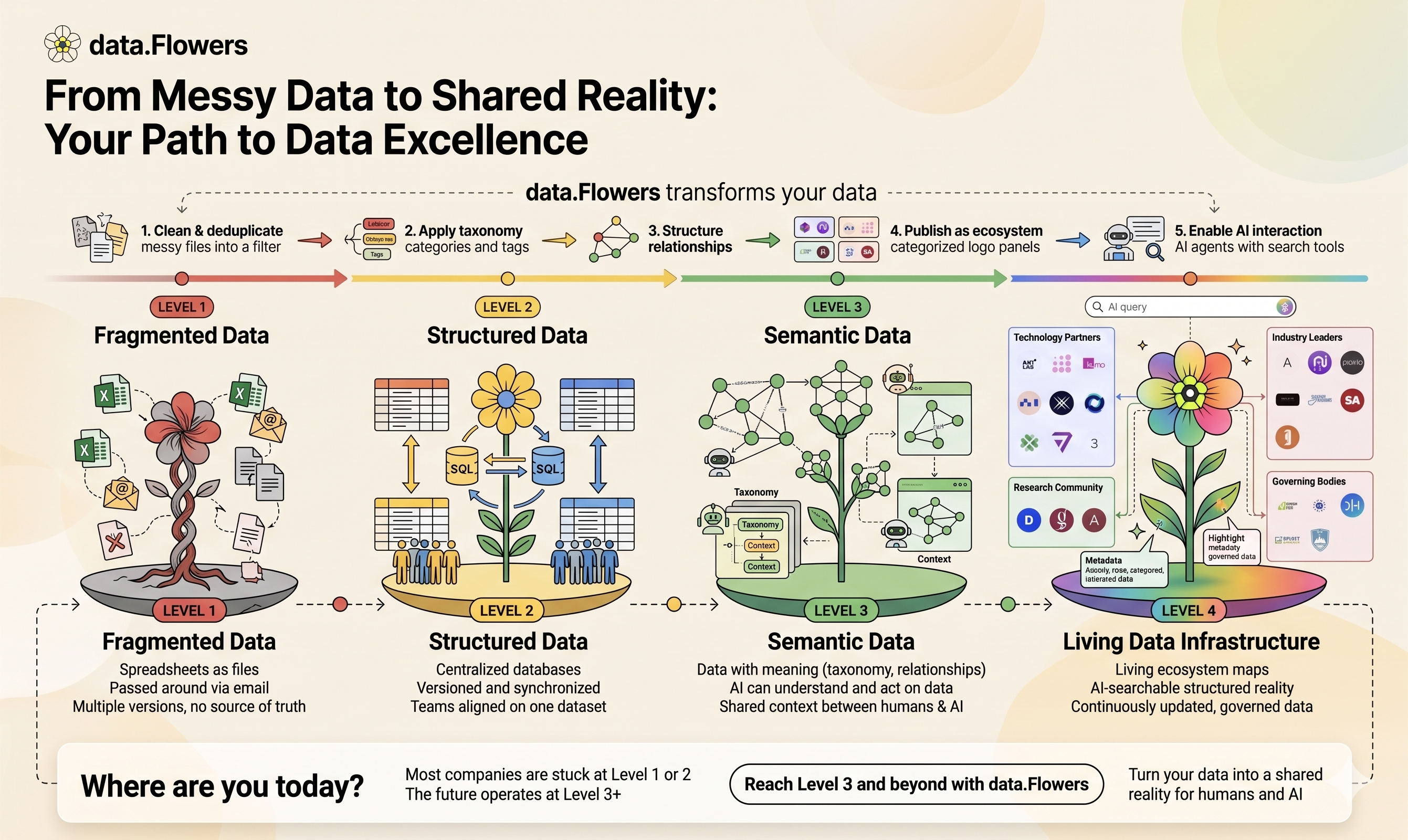
Every organization has data. Far fewer have a shared reality.
Most teams work with scattered spreadsheets, exports, attachments, and one-off lists. People send each other files, and get on calls to explain which field means what. By default, data isn't to be trusted. Right now, AI systems are trusted to operate on top of all that.
Data excellence is not binary. It is a progression from fragmented files to structured systems, then from structured systems to semantic data that humans and AI can interpret together. The next step is living data infrastructure: continuously updated, governed maps of the real world.
Level 1: Fragmented Data
At Level 1, data lives as files. Spreadsheets are passed around by email. Copies multiply. Every team member may have a slightly different version of the same list.
This is where many organizations start because spreadsheets are flexible and familiar. But flexibility becomes fragility once the data needs to be shared, queried, governed, or connected to AI workflows. There is no durable source of truth, and there is no reliable structure for intelligence to build on.
Level 2: Structured Data
At Level 2, data moves into centralized systems. Tables, databases, and synchronization rules create order. Teams can agree on a dataset, and sometimes version it.
This is a real improvement. Structured data reduces ambiguity, increases efficiency, and helps teams coordinate. But it's a lot of work operating within the structure: structure often shackles us into a rigid forms, strict rules, and outdated categories. We're trapped by data rather than being empowered by it. We're forced to use software applications, and rarely get to touch the data itself.
Level 3: Semantic Data
At Level 3, data has meaning. Taxonomies, relationships, entity types, metadata, and context make the dataset understandable beyond raw fields and rows.
This is the level where AI starts to become useful. An AI agent can reason over relationships, retrieve the right context, and act with more precision because the data is not just organized. It is described. Humans and AI can work from the same conceptual model instead of improvising around stale exports and limited software applications.
Beyond Level 3: Living Data Infrastructure
data.Flowers is built for the next layer: living data infrastructure.
We clean and deduplicate messy data, apply smart taxonomies, structure relationships, and publish the result as interactive ecosystem maps with AI search. The output is not simply a nicer spreadsheet. It is a common operating picture: a living map of companies, people, organizations, metadata, and relationships that can be searched, governed, and continuously improved.
This matters because AI is made from data. If the underlying data is stale, duplicated, poorly governed, or semantically thin, the intelligence built on top of it will inherit those limits. Garbage in, garbage out is still true. The difference now is that bad data can scale into bad automation.
Living data gives intelligence better ground. It keeps knowledge connected to the people and organizations that shape it. It gives teams a common surface for review and governance. It creates the structured reality AI systems need if they are going to assist rather than hallucinate.
We work with data directly, instead of being disintermediated by software.
The Transformation Layer
The data.Flowers workflow follows a simple progression:
- Clean and deduplicate messy files into a usable foundation.
- Apply taxonomy so categories, tags, and entity types have meaning.
- Structure relationships so the map reflects how the ecosystem actually works.
- Publish as an ecosystem map that people can explore and maintain.
- Enable AI interaction through search, retrieval, and context-aware querying.
The goal is not to replace human judgment. The goal is to give human judgment and AI systems the same reliable terrain.
Where are you today?
Most organizations are still stuck at Level 1 or 2. The future operates at Level 3 and beyond: semantic, governed, living data that humans and AI can share.
Reach Level 3 and beyond →